
When a whale carcass was towed to Seal Island in False Bay, known as a spot where great white sharks hunt, one might have expected a feeding frenzy with the big predators fighting each other and ripping into whatever they could bite off.
Turns out this was not the case. According to Alison Kock, principal scientist of the Save Our Seas Shark Centre and Shark Spotting Programme, the sharks were highly selective in what part of the whale they ate, and showed very little aggression towards each other.
"Contrary to their reputation as mindless killers, the level of selectivity for which parts of the dead whale they ate was extraordinary.
"They targeted the energy-rich blubber, often making repeated 'test bites' where no flesh was removed, and removing flesh only once they had determined it was what they wanted. If they got a mouthful of muscle, they often spat it out," Kock said yesterday.
The 11m dead Brydes whale was spotted a couple of weeks ago by Chris Fallows of Apex Expeditions floating towards Miller's Point. Had it washed ashore, the authorities would have had to remove the carcass, a time-consuming and expensive operation. The authorities therefore gave permission for the SA Navy to tow the whale to Seal Island, where the sharks could dispose of the carcass by feeding on it.
"And it gave us a great opportunity to document white shark behaviour and record the number of sharks in the area," Kock said.
Over nine days she recorded 30 different sharks feeding on the whale. Each shark's dorsal fin is different, providing a kind of "fingerprint". Many Kock recognised, but some she had not seen before.
"I was surprised by the number of white sharks that fed on it. They showed very little aggression toward one another, often feeding side by side."
Their highly selective feeding, spitting out muscle if they bit into it by mistake, may shed light on why over 70 percent of white shark attacks on people are "bite and release", Kock said.
"It is evidence that when they bite into a surfboard, or kayak or person wearing a wetsuit, they can immediately determine it's not something they want to eat," she said.
The sharks reduced the 11m whale carcass to 2m of muscle and bone in nine days.
melanie.gosling@inl.co.za
• This article was originally published on page 1 of Cape Times on September 20, 2010
Monday, September 20, 2010

Monday, September 13, 2010
Spring 2010 Newsletter
Dear fellow shark lovers
What a winter! World Cup Soccer fever hit Kleinbaai with a vengeance and we hosted a record number of trips. Brazilian, Mexican, Dutch and many other overseas visitors joined us for unforgettable encounters with great white sharks. Our wonderful sharks performed beautifully for their World Cup crowd.
Thank you to all our visitors who gave us a fun and cosmopolitan winter – and a special thank you to our Mexican visitors who treated us to tastings of real Mexican tequila after a great day at sea!
Our spring sightings are well under way. The water has warmed up earlier this year and we're already looking forward to greeting our many summer visitors – not least the southern right whales. Come and see these magnificient creatures as they bask in our waters from September to January. They come close inshore to calve and mate. We view these marine wonders with awe and respect.
And the winner is...
Our White Shark Projects photo competition has closed and excited entrants are awaiting the announcement of the winner on 14 September. Who caught the definitive white shark shot? Or maybe it was a moment captured on the faces of friends or family that caught the judges' eye. Our winner will join us for a wonderful 21-day volunteer programme. We can't wait to welcome you aboard.
Our conservation work goes international
We have always been serious about the contribution we make to local data bases on the sightings and movements of white sharks in our waters. Thanks to Michael Scholl, we now are also submitting our information to the International White Shark PhotoID Project. A team of scientists led by a British university are building a computer system aimed at identifying every great white shark in the world's oceans. The scheme involves the equivalent of fingerprinting the animals, storing images of their unique dorsal fins on a database.
This is a wonderful development in shark conservation efforts. When researchers can source data on a global scale, they can really start to understand the habits and conservation needs of these threatened creatures.
It's a particularly exciting time, therefore, for our new marine biologist to be joining us. David Arnott is all set to continue our valuable work in data gathering and collating. Welcome on board, David. We look forward to fascinating and fun times with you.
Community update
On Tuesdays, the White Shark Projects recycling Swop Shop encourages children from our local, often impoverished, community to swop recyclables for basic school supplies, as an added bonus, they also get a bowl of steaming soup. A particularly cold winter has meant a long line at the soup kitchen. Somehow volunteer Nellie Moolman and her right hand Veronica Msopi have managed to keep up with demand. 'We've served about 160 bowls of soup every Tuesday,' laughs Nellie. It seems her bean soup is in demand! Thank you for the love you show these children, Nellie and Veronica.
Don't forget, if you live nearby, the Swop Shop is always in need of school supplies and basics to encourage our young recyclers.
A Little Shoppe with a big mission
We've opened a branch of The Little Shoppe in Kleinbaai! This is an exciting extension of our efforts to promote sustainable tourism in our area. Set in the harbour, the shop sells only locally produced products and is a vibrant place for clients and artists to come together. Everything is handmade and everything has a story to tell - either that of the artist or the materials used. We hope that sales to tourists will develop into larger orders or exporting opportunities. Artists are from disadvantaged communities of the Overstrand and own their own products. The Little Shoppe is in a Closed Corporation with a 67% black ownership and with the dynamic Alda du Plooy leading the project.
Come and see our wares!
I'll be signing off now. It's a clear and sunny morning in the Overberg. Just perfect for sharks!
Very best wishes

Wednesday, April 7, 2010
Gansbaai's Sharks in Summer
This year has according to both skippers been the best February that we have ever had. Every trip has resulted in us seeing multiple sharks in the Jouberts Dam area opposite Pearly Beach. One trip that sticks out in mind involved a 3.5m female doing a full vertical breech 20 meters off the stern for absolutely no reason!! There were no prey items in the area, our visual target (the bait) and chum line which creates the artificial scavenging scenario for the shark was moving away from the boat in an SE direction. Given the fact that we were only in 10m depth of water the shark must have been doing in excess of 45kph the launch itself vertically straight out of the water (thanks goes to Mary one of our white shark projects volunteers who has graduated in physics for this estimate). Only a privileged few saw this spectacle (ah the benefits of getting involved with chumming!), the white underbelly gleaming in the bright sunshine was an awesome sight to behold! It also acts as a stark reminder of how beautiful and powerful these animals are.
This month has also seen some unusual environmental conditions, the water has been as warm as 21 C (the average temperature this time of year is normally between 9-14 C), and on some days the visibility has been nigh on perfect enabling those on board to see to the sandy bottom of Jouberts dam. The warmer water temperatures have resulted in the sharks being more active, and more willing to expend energy chasing the bait. One shark in particular called “Mickey” due to the pattern he has on his dorsal fin seems to relish the opportunity to rush the bait from deep, and on one occasion the bait line had been thrown out for the first time on an afternoon trip and before the bait handler had time to reach down to pick up the rope Mickey had the tuna head in his mouth and didn’t intend to let go!
We have also seen on two occasions the chum line attracting another great marine predator in this area a little lower down the food chain, that predator being the cape fur sea. We had two good working sharks both females and around 3M in length that had stayed around the boat for over an hour when the seal appeared. It swam towards the boat investigating the source of the chum, anticipation grew on the boat with everyone expecting the shark to burst from the depths and predate on the seal. Instead the seal came close to the boat and then it left without incident. The two sharks then reappeared 5 minutes later, given the sharks array of senses there is no doubt that the shark knew the seal was present (and vice versa) but chose not to attempt an attack. On another occasion a seal not only popped up in the chum line and swam to the boat but decided the tuna head on the bait line looked like quite a tempting free snack. The seal proceeded to attach itself to the tuna head and began to chew it!! Once again the seal left without incident despite there being sharks in the vicinity that we had been lucky enough to see on a regular basis. Who knows what amazing sights we will be privileged to on our next trip!! To book your trip, visit us on www.whitesharkprojects.co.za
Thursday, December 10, 2009
Empowerment in White Shark Projects
In a move to synergize its vision and mission for the future - a white shark diving and viewing company based in Gansbaai in the Western Cape Region of South Africa - White Shark Projects announced the transfer of 25% ownership of White Shark Projects CC to Black Economic Empowerment (BEE) partners.
The new partnership will see the White Shark Projects Employees Trust (hereafter referred to as “WSP Employees Trust”) acquiring 25% of White Shark Projects CC. The deal puts White Shark Projects CC firmly on the road to full BEE compliance.
White Shark Projects CC has for some time stated its intention to introduce a BEE shareholder and to this end has held discussions with various parties.
The WSP Employees Trust was set up by White Shark Projects in 2009. The WSP Employees Trust was established to provide assistance to previously disadvantaged employees at White Shark Projects CC; and to provide the WSP Employees Trust with a sustainable source of income in order to fulfil its objectives. The ultimate beneficiaries of the WSP Employees Trust are the previously disadvantaged employees at the company, their families and the communities that it supports.
Charmaine Beukes, Owner and Director of White Shark Projects, said: “Central to all initiatives is our emphasis on people being our greatest asset. This is reflected in our choice of our black economic empowerment partner (The WSP Employees Trust), the diversity of our staff, our capacity-building social investment programmes and in our preferential procurement and enterprise development achievements.
Abraham Newman, an employee at White Shark Projects and trustee-holder in the WSP Employees Trust commented as follows: “The owners and management team at White Shark Projects has not only showed the way by empowering others – but also empowering our business in the true sense. I am smiling – because I know that I am working at a company that values people centredness, integrity, performance and overall sustainability in a very exciting and challenging South African environment. Surely, this is the start of new beginnings – and has ignited a renewed fire of passion for sharks and service amongst the “Shark Team”!”
Notes about the company: White Shark Projects CC has been established in 1989 and is a world-leading organization that focuses on the conservation of great white sharks through responsible tourism and research. We are involved in conservation, film, education, diving and viewing.
The expectations of clients at White Shark Projects are met by excellent customer service, good value, and operational efficiency. The crew and staff are distinguished by their functional and technical expertise combined with hands-on experience – ensuring the clients effective and professional service.
This Fair Trade Accredited in SA company works closely with the SA Shark Conservancy and is full members of SATSA, SKAL International, Cape Town Tourism, Open Africa and Gansbaai Tourism.
Monday, December 7, 2009
CONSERVATION, EDUCATON AND DEDICATION - THE "THREE MUSKETEERS" OF THE WHITE SHARK'S ULTIMATE SURVIVAL!
Conservation encompasses many things - from the very air that we breathe, to the great rain forests of the Amazon, from every endangered species of animal or bird, to the smallest creature in the ocean, to one of the most feared - the Great White Shark, which is the focus of this article.
Sharks are quite possibly one of the most feared sea creatures. From the smallest sand shark to the gigantic whale shark, they are sleek, muscled and very agile. Wonderfully equipped predators, they can sense blood from more than a kilometer away! They are greatly feared by other creatures beneath the waves. By nature they are unpredictable, especially true of the most magnificent of all --- the Great White.
What do YOU know about the Great White? Allow me to give you some facts which will broaden your knowledge and increase your understanding of these amazing creatures.
The white shark is the largest predatory fish in the oceans of the world. It can grow to a length of at least 7 meters and weigh over 3 tons!
Although intelligent, natural learners, they cannot be trained by human contact. Senses are highly developed and they can smell fish or blood from at least 100 meters away.
The largest concentrations of white sharks is in regions where water temperatures range between 10 and 20c. The South African coast, close to the city of Cape Town, is particularly prevalent.
Thousands of tourists from all over the world visit the Overstrand region of the Cape Coast each year. They are attracted by the unique beauty of the land and marine environment. They come because they are passionate about the conservation of these magnificent sea creatures, always willing to learn and do their "bit".
And of course, they come to participate in the exciting "cage shark dives" especially to see the Great White close up in its natural habitat!
By:
Charmaine Beukes WSP
Would YOU like to experience the absolute magic of SHARK CAGE DIVING, further education and much, much more. For more info on our community projects, unsurpassed hospitality and exciting tours, visit www.whitesharkprojects.co.za
Monday, November 30, 2009
Fin Id's as observed by White Shark Projects
FIN-ID CATALOGUE:
Over the last year consistent data has been collected on individual shark sightings. For the purposes of this document 4 individual sharks are included to show residency patterns and the periods for which some individuals remain around the Dyer Island area.
The information recorded within may not thoroughly represent the population dynamics of the species in this area. This information cannot be used to represent the population as a whole as there is a large amount of variability within the behavioural repertoire of each individual.
There are undoubtedly some individuals that will not be observed around cage diving vessels and there is no evidence to suggest that a single animal will continue to approach the boat with every successive sampling period. Some individuals may learn to avoid the vessel to due to the effects of negative conditioning and the lack of food rewards.
The 4 individuals appearing in this document have become well known over the last year and as a consequence have been named.
I have chosen these specimens to show other areas of research interests such as healing abilities, residency, growth rates and seasonal visitation.
Shark 1 – re-sights: Shark 2 – re-sights: Shark 3 – re-sights: Shark 4 – re-sights:
28/11/2008 28/04/2008 14/06/2007 15/12/2008
01/12/2008 10/10/2008 21/06/2007 18/12/2008
06/12/2008 03/06/2009 03/06/2009 21/12/2008
15/12/2008 22/06/2009 19/06/2009 26/12/2008
18/12/2008 01/07/2009 20/06/2009 29/12/2008
04/07/2009 02/07/2009 31/07/2009 11/02/2009
17/07/2009 03/07/2009 02/08/2009
18/07/2009 05/07/2009
21/07/2009 24/08/2009
30/07/2009 04/09/2009
04/09/2009
10/09/2009
Shark 1 - Kimbo:
Kimbo was originally observed at a size of 2.3 metres on the 28/11/2008. Our first observations were made in the summer grounds known as Joubert’s Dam. The right hand side of the dorsal has a ‘√’ shaped pigmentation blemish and the left hand side has a small heart shaped pigmentation blemish. Situated just anterior to the dorsal on the left hand side there was a large +/- 20 cm long, +/-3 cm deep cut. Over November and December we were able to track the healing of this cut which was astonishingly quick. Read more: Healing powers of the Great white shark. Kimbo had become very familiar with the cage diving vessel and appeared to learn and adapt her strategy over time. We are therefore recording all behaviours around the vessel to investigate cognition, memory and learning capabilities. Over the last year I believe Kimbo has grown into the offshore island population. She moved to the island from the inshore nursery ground and remained there till the end of the winter season into September 2009. It will be very interesting to see whether this particular individual moves back down into the nursery grounds for the summer. Since November 2008 this juvenile shark has increased in length by 20 cm.
Shark 2 - Nemo:
This particular individual was first identified in August 2007. Nemo is a juvenile female and was initially recorded at a total length of 2.2 metres, she has been a long term resident of the Dyer Island area.
There are a few young individuals that have remained in the area for extended periods of time (>9 months). Many of the sharks we see are highly transient remaining in the area for short periods of time (2-4 weeks), with many other animals that we do not identify satisfactorily.
This small shark had severe wounds to the dorsal fin causing it to curl over and eventually tear away leaving two thirds of the dorsal with fragmented tissue. Roughly 70% of the right hand pectoral fin is missing. It would appear that the pectoral fin was initially compressed downward. Other marks on the body suggest that she may have been caught in a net or line. The reason Nemo has shown such a large degree of residency could be a result of her injuries. Over the last year Nemo has increased in length by 30 cm and continues to surprise us that she has made it through another season, getting bigger and stronger every time she is observed. Nemo was observed on several occasions between August 2007 and October 2008, a period spanning both the summer and winter periods and locations. During our first trip to Joubert’s Dam, October 2008, Nemo made an appearance and then was not seen until June 2009. We do not know if Nemo remained in the local area or moved elsewhere along the coastline.
Shark 3 - Slash-fin:
This 3.5metre male has been a long term winter visitor to Dyer Island, arriving right in the peak season for predatory activity (June, July & August) and leaving shortly after. Slash-fin is aptly named due to the 3 large gashes that run through the dorsal fin. Initially the fin was severely damaged with the pieces moving independent of each other. Over time the dorsal fin has fused back together. Slash-fin was originally named and spotted in 2004. This male has returned to the island every winter since. Although white sharks are not considered to be territorial, Slash-fin is only usually observed at a location called South of Geyser. It is very unusual to observe him around other areas of the reef system during his brief visits unless it is when he initially arrives at Dyer Island.
Shark 4 - Gash:
Gash was originally sighted in Joubert’s Dam throughout December. When we first observed this small 2.5 metre female there was a huge gaping wound on the dorsal surface just anterior to the dorsal fin. It appears this wound was most likely caused by a boat propeller. Gash and Kimbo have given us the opportunity to try and establish how fast white sharks are capable of healing after severe trauma. We did not encounter Gash in January and only caught a brief glimpse of her on one trip on the 11/02/2009. This allowed us to gauge how well her wounds had healed throughout this period. The results were astonishing with her showing a very rapid rate of tissue recovery and mobility. It is unclear whether this particular individual had remained in the area throughout January or left the area and returned. There were reports of her by other vessels. This is a clear limitation of the dorsal fin identification catalogue as a method to continually track the localised movement patterns of sharks in the area.
Conclusion:
The population composition of this area is very complex. There appears to be two distinct seasonal grounds, the South African summer and winter compositions. The composition during summer typically consists of large (4.0 metre) females and juveniles (1.2-2.5 metres), males and intermediate (2.5-4.0 metres) size classes are usually absent or rare. During the winter season the shark’s frequent Dyer and Geyser islands for the purposes of hunting the seasonal abundance of Cape fur seals. Males and females are observed in equal proportions and intermediate size classes (2.5-4.0 metres) are usually common.
Sharks that are approaching adulthood may navigate South Africa’s coastline and stop at these off shore islands for short periods of time to take advantage of the abundance of food. They do not appear to stay for long periods of time, usually <1 month. It could be that once they have exhausted the food resources in a particular area they move elsewhere to hunt. Whilst they are hunting I believe that some individuals such as Slash-fin are semi-territorial, having preferred hunting locations and drop off points along known seal run-ways. The younger animals appear to float between hunting sites and don’t appear to hold territories for any sort of consistent time period.
Nemo and Kimbo were summer sharks, observed down in the shallows in the nursery ground area. Both sharks would later be present at the island in the winter suggesting potential recruitment into a more transient population with a highly migratory mode of lifestyle. We will have to wait and see if any of these animals show up in the summer grounds this season.
To follow these sharks, visit our website: www.whitesharkprojects.co.za
Wednesday, November 4, 2009
Some interesting facts on great white sharks

The shark of fiction and the shark of fact is not the same shark.....
Great white ID
Quite simply, great whites are grey on top with a white underbelly – for perfect camouflage from above and below. The white belly blends in with the sky and the dark back blends in with the rocks below.
Great white addresses
Great whites swim the oceans of the world. Concentrations, or 'hot spots', are found in the temperate waters of south-western Australia, South Africa, California and Mexico. The densest known population is right here, around Dyer Island, South Africa!
They are pelagic fish. That means they prefer the upper layers of the sea, but also venture down to 1 280m. They are mostly seen in coastal waters where the pickings are rich. Seals, whales, dolphins, other sharks and large bony fish make a good shark diet.
We've recently realised that great whites spend a lot of time in the open ocean too. When 'Nicole', a female great white, was tracked to Australia and back, we learned so much more about their migration and behaviour. In fact, great whites have the longest recorded migratory range of any marine creature. Nicole covered a staggering 22 000km from Dyer Island (South Africa) to western Australian and back in just under nine months! Her average swimming speed was 4.7km/hr. She spent 60% of her time in the top 5m of water, 20% in the area below that and 20% down at her maximum depth of 980m.
Favourite foods
The white shark is an apex predator – right at the top of the feeding pyramid – and is vital to a healthy marine ecology. The only animals who attack them are other great whites, sperm whales and orcas.
These apex predators take their pick of the buffet, choosing fish, smaller sharks, turtles, dolphins, seals and sea lions – or even the blubber of dead whales.
Great whites are partly warm-blooded. Most of their body is kept at 14°C above the temperature of the surrounding water. They are economical with their calories and can go for weeks between meals. With one bite, great whites gobble about 14kg of flesh, and can gorge on several hundred kilograms of food. Do they like the taste of humans? Well, humans are not exactly healthy for a great white because its digestion is too slow to cope with the human body’s high ratio of bone to muscle and fat...
Vital statistics
Great whites of up to 7m (21ft) long have been reliably reported, but their average length is around 6m (18ft). They're over a metre long at birth (3 to 5ft).
No one really knows how long great whites live. It's hard to find out because they lead lonely lives and are so migratory. Research in recent years should bring us closer to knowing.
Power-sensing!
Great whites have powerful sensing mechanisms – a mega sense of 'smell' and an ability to sense the electrical fields radiating from living creatures.
They 'breathe' via gills, so nostrils are solely for sniffing out prey. Each nostril is divided in two, separating the water into two flows, one incoming and one outgoing. The water flows over sensory organs covered with millions of olfactory cells connected to the 'smelling' centre of the brain. The great white is one big swimming nose!
They hunt down prey with an unusual electrical field detection system. Minute capsules filled with a gel-like substance are sensitive to electrical discharges as small as .005 microvolts! Sensory cells pick up these signals and transmit the information to the brain. All marine creatures generate small electrical fields – where their skin meets the water, from the mucous membranes in the mouth and gills of fish, or from the blood of wounded animals. The great white 'reads' the signals and decides who's swimming normally, who's panicking, or who is incapacitated.
A sharky grin
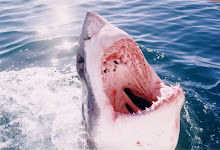
When a great white attacks, it thrusts its jaw forward. This makes for the widest possible grab and lets teeth grasp the prey.
Sharks' teeth change over time depending on what they eat. Smaller sharks, less than 3m, generally eat fish. These young sharks have pointed teeth so that their jaws can pin prey. As they get bigger, they start to add larger prey such as seals and dolphins. To dismember such big animals, their top teeth become stronger, serrated and triangulated. The lower teeth stay pointed so that the shark can still pin the prey.
What's with the eyes?
Much like human eyes, shark eyes have a light-sensitive layer at the back called the retina. A shark's retina has millions of microscopic rod cells helping the shark see in dim light.
In low light, shark eyes shine like a cat's. That's because the tapetum, a layer of shiny cells behind the retina, reflects light back through the eye helping them see even better in low light. In bright light the tapetum can be covered with dark cells to cut reflection and protect the retina.
Sharks have two eyelids to protect their eyes. Often the eyelids don't meet. Some sharks have a third eyelid (nictitating membrane) – useful protection when attacking prey. If there's no nictitating membrane they roll the eyeballs back under the true eyelids – and there's the white-eyed look.
Mystery and reproduction
Male great whites are ready to breed when they reach approx 3.8m long. Females are ready at approx 4.8m. Though they both have a hole near the pelvic fins called the cloaca, you can see the difference between male and female sharks.
Male sharks have modified pelvic fins called claspers. They also have two muscular sacs in their abdominal wall which they fill with seawater. Internally males have testes that produce sperm and secrete male hormones.
Female sharks are mostly bigger than male sharks. Other than that, they look the same, except they don't have claspers. Inside, they have a pair of ovaries where female hormones and eggs are made – interestingly, usually only the right ovary makes eggs.
We know almost nothing about how and where great whites mate. Some believe that making a large kill has a soporific effect on them that may lead to mating.
We have never seen a great white give birth, though we know they are ovoviviparous. That means the eggs grow inside the female, hatch there and carry on growing until they are born between spring and summer. They give birth to between 4 and 14 pups and may have only 4 to 6 litters in a lifetime. At birth, the pups are about 1.5m long and are already able hunters. They grow quickly, reaching 2m after their first year of life.
White shark titbits
White sharks store extra fat in two large livers and draw on these stores when times are hard. The livers help to keep the shark buoyant.
The dorsal fin is flexible (bendy) and works with the tail to make the shark agile.
The dorsal fin is as individual as a fingerprint – the trailing edge and the arrangement of notches in the fin is unique.
The great white is the only apex predator that hasn't been kept successfully in captivity. Where it's been tried, the sharks were released due to stress.
Conservation: It's tough at the top
Being at the top of the food pyramid means white sharks are vital to a balanced marine ecology. They control the populations of prey species and weed out the sick and wounded. A healthy ocean depends on a robust population of apex predators. Sadly, the survival of the great white is threatened by the ignorance and greed of humankind who continue needlessly to slaughter them. Responsible tourism promotes conservation, awareness and respect for the great white shark. We work towards sustainable populations of great whites in the waters of the world.
To join in our shark tourism trips, visit www.whitesharkprojects.co.za
Subscribe to:
Posts (Atom)


 Posts

